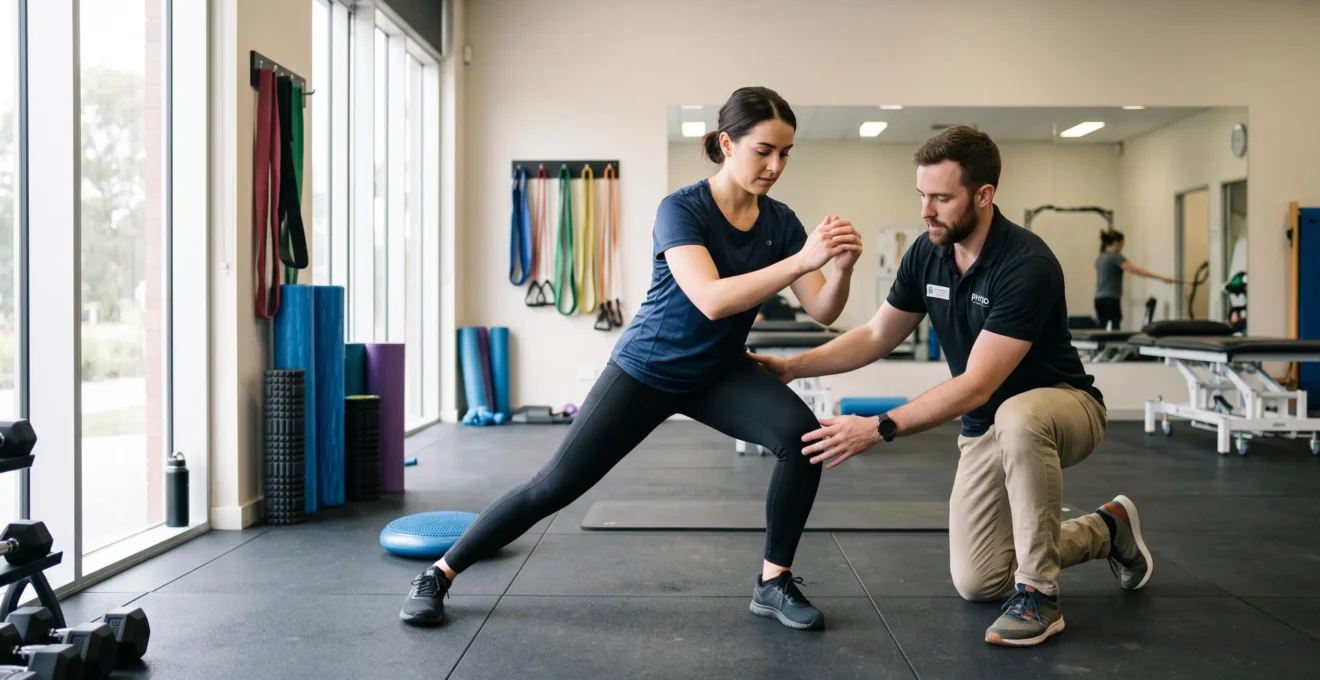
Recovering from anterior cruciate ligament (ACL) reconstruction is a long process, and the exercises you perform in the weeks and months after surgery largely determine the stability of your knee and your ability to return to sport. The right movements, done at the right time and under the right supervision, protect your graft while rebuilding mobility, strength and confidence. This guide walks you through the essential exercises phase by phase, explains how to progress safely, and highlights the signs that should prompt a specialist consultation.
Patients seeking further information about anterior cruciate ligament surgery can consult Professor Etienne Cavaignac, whose specialist practice focuses on knee surgery. Understanding the surgical procedure and the factors that influence recovery can help patients prepare for discussions with their medical team and better understand the role of rehabilitation in their recovery.
Direct answer: Essential exercises after ACL surgery evolve through phases: early mobility and quadriceps activation, then progressive strengthening and balance work, and finally sport-specific drills. Progression should always follow objective criteria validated by your surgeon or physiotherapist, not a fixed calendar.
Why exercise matters after ACL surgery
Exercise is an essential component of recovery after ACL surgery. The reconstruction performed by your surgeon restores ligament stability, while structured rehabilitation helps recover knee mobility, muscle strength and neuromuscular control. The pace of recovery depends on several factors, including the surgical procedure, associated injuries and adherence to an individually adapted rehabilitation program. Without consistent exercise, two problems appear quickly: the knee stiffens, and the quadriceps muscle wastes away, sometimes losing visible volume within days.
A carefully progressed program directly reduces this muscle atrophy, restores full range of motion, and rebuilds the neuromuscular control that keeps your knee stable during pivots and jumps. Following the exercises prescribed by your own surgeon and physiotherapist — in order, and at the right intensity — remains the single most important factor for long-term knee stability.
Why supervision matters: Every exercise in your program should be validated by your surgeon or physiotherapist. They adapt loads and movements to your graft type, surgical findings and personal progress.
Which exercises follow each phase of recovery?
ACL rehabilitation is traditionally organised into successive phases, each with its own objectives. Rather than listing exercises by week, it is safer to connect each exercise to its phase and to the clinical goal it serves.
Early phase: mobility and quadriceps activation
In the first days and weeks after surgery, the priority is to protect the graft while restoring extension, controlling swelling and waking up the quadriceps muscle. Typical exercises include isometric quadriceps contractions (pushing the back of the knee down into a towel), heel slides to progressively regain flexion, straight-leg raises, and ankle pumps to support circulation. Walking with crutches is gradually loaded according to your surgeon’s instructions.
These movements may feel underwhelming, but they are the foundation of everything that follows. A knee that cannot fully extend early on becomes much harder to rehabilitate later.
Intermediate phase: strengthening and proprioception
Once basic mobility is secured and swelling is under control, exercises shift towards closed-chain strengthening — squats to a controlled depth, step-ups, split squats or lunges — along with hamstring work and progressive resistance exercises. Proprioception becomes central: standing balance on both feet, then on one foot, then on unstable surfaces such as foam pads, retrains the sensors that stabilise your knee during unexpected movements.
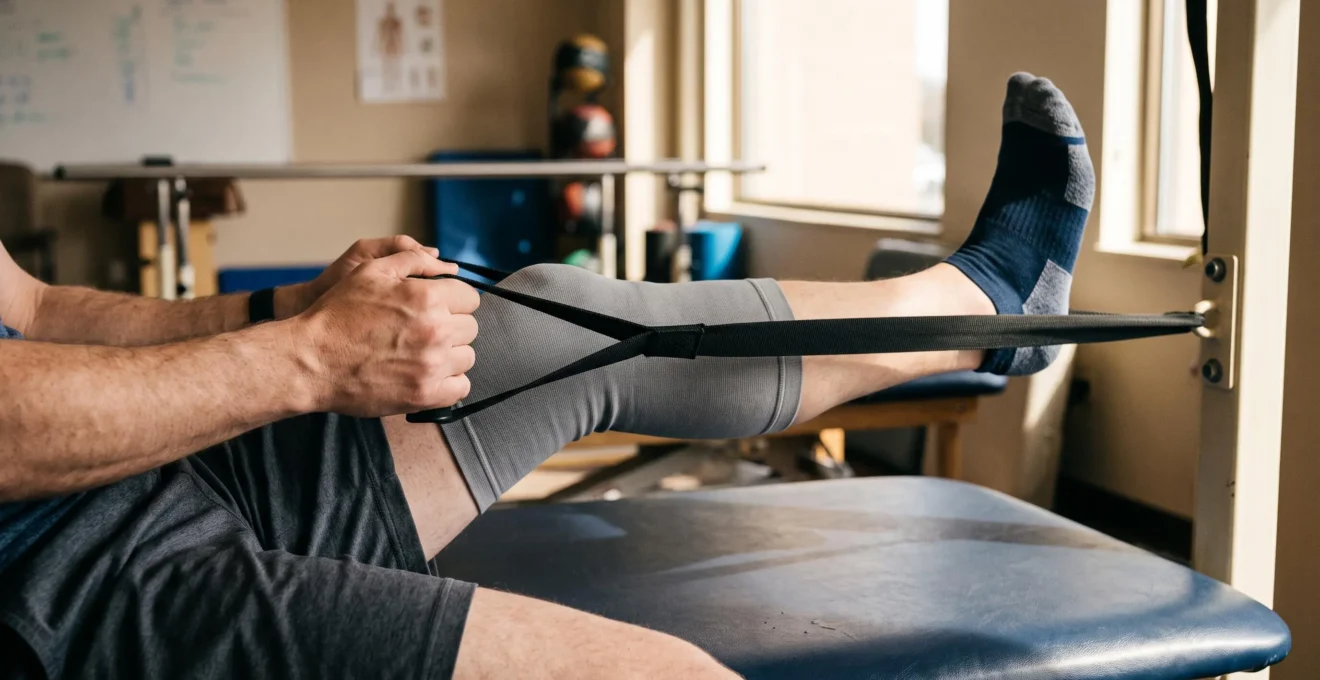
A simple progression illustrates how exercises evolve: a bipodal balance exercise, eyes open, on a flat surface may become a unipodal balance exercise on a foam pad with eyes closed and controlled upper-body movement. The movement looks different, but the underlying objective — training stability — is the same, only harder.
Advanced phase: running, plyometrics and return to sport
The advanced phase introduces running, bilateral then unilateral hops, change-of-direction drills and sport-specific movements. These exercises stress the graft and the surrounding muscles under conditions closer to real sport. They should only be started once objective criteria are met: sufficient muscle symmetry, pain-free loading, stable landing mechanics and the explicit green light of your rehab team.
One widely used benchmark is a Limb Symmetry Index (LSI) of the quadriceps of at least 90% compared with the uninjured side before return to sport. A limb symmetry index (LSI) of at least 90% is commonly used as one benchmark when assessing readiness to return to sport after ACL reconstruction. However, it should be interpreted alongside clinical findings, functional testing, movement quality and the demands of the intended sport. The specific French study supporting this threshold should be cited directly. Chronological timelines (for example “running at three months”) remain purely indicative — your surgeon’s clinical criteria are what matter.
Exercises mapped to phases
- Early phase: isometric quadriceps, heel slides, straight-leg raises, controlled walking.
- Intermediate phase: closed-chain strengthening, hamstring work, single-leg balance progressions.
- Advanced phase: running, hops, change-of-direction and sport-specific drills.
- Every transition between phases depends on clinical criteria, not calendar weeks.
How to progress safely without risking re-injury
Safe progression rests on a simple principle: your knee’s response guides your next step, not the calendar. Pain, swelling and loss of range of motion after an exercise are objective signals that the stimulus was too high. Reducing load or volume, then reintroducing the exercise more gradually, is almost always the correct response — not stopping rehabilitation altogether.
A useful rule is to change only one parameter at a time between sessions: either the load, or the volume (sets and repetitions), or the difficulty (unstable surface, speed, single leg). Changing several at once makes it impossible to understand what your knee tolerates.
Warning signs to recognise: sharp or deep joint pain during or after exercise, persistent swelling the day after a session, a feeling of instability or giving way, a true locking of the knee, or pain that initially improved then suddenly returns. These signs warrant stopping the exercise and contacting your surgeon or physiotherapist.
It also helps to distinguish normal muscular discomfort from worrying joint pain. A diffuse soreness in the front of the thigh after a strengthening session, improving within 24 to 48 hours, is usually a normal training response. A sharp pain inside the knee joint, swelling that reappears each time you train, or a sense that the knee “slips” is a different story and should always be discussed with your rehab team.
How to structure your weekly ACL rehabilitation routine
Rehabilitation is as much about consistency as it is about intensity. A realistic weekly structure alternates loading days with lighter recovery days, keeps daily mobility work, and distributes strengthening and balance sessions so your knee has time to adapt.
In an intermediate phase, a typical week might look like three strengthening sessions (for example Monday, Wednesday and Friday), daily short mobility routines focusing on full extension and progressive flexion, and two dedicated proprioception sessions on alternate days. Light cross-training such as stationary cycling can complete the week, if cleared by your physiotherapist.
- Plan around recoveryPlace strengthening sessions on non-consecutive days so your knee can absorb the load without accumulating swelling.
- Keep daily mobilityShort, frequent mobility and quadriceps activation sessions matter more than one long weekly workout.
- Track your knee’s responseRecord pain, swelling, range of motion and perceived effort after each session to spot trends over time.
- Adjust before pushingIf any marker worsens for several days, scale back one parameter before increasing anything else.
A simple rehabilitation journal — paper or digital — makes a real difference. By noting the exercises performed, pain levels, range of motion and any swelling, you give your physiotherapist concrete data to adjust your program and detect early signs that progression should slow down.
When should you consult a knee specialist?
Even with a well-structured protocol, certain situations call for a specialist’s opinion. Persistent instability or a feeling of giving way during normal activities, a knee that locks or blocks, pain that had improved and then suddenly worsens, or the absence of expected progress at a key stage of your protocol all deserve prompt medical evaluation. The goal is not to interrupt your rehabilitation, but to confirm that nothing in the joint — graft, meniscus or cartilage — requires closer attention.
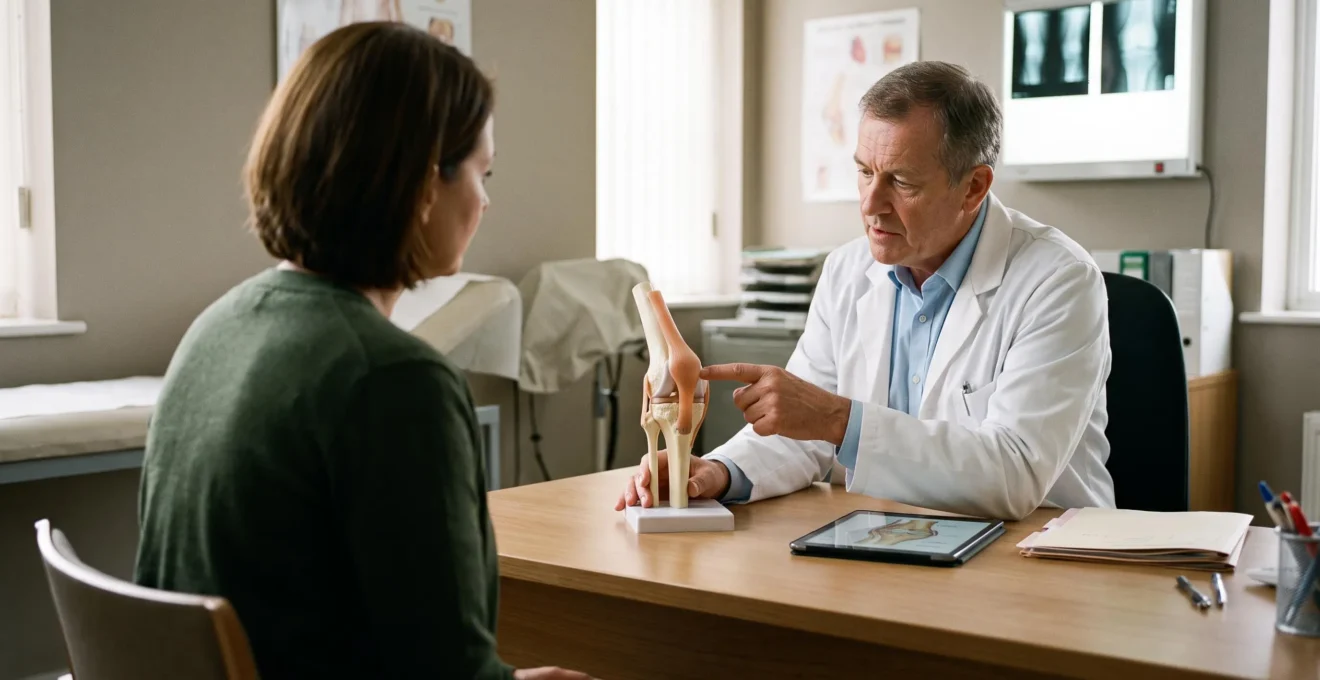
Associated injuries can also affect the rehabilitation plan. Lateral meniscus root tears are among the injuries that may accompany an ACL rupture, and their presence can influence postoperative precautions and exercise progression. The rehabilitation protocol should therefore account for any associated meniscal injury and the specific surgical procedure performed.
Which exercises should I do first after my ACL operation?
The earliest exercises usually focus on restoring full knee extension, waking up the quadriceps with isometric contractions, performing heel slides to regain flexion, and starting controlled walking with crutches. Your surgeon or physiotherapist defines the exact list and loads based on your surgical technique.
How do I know when my knee is ready for the next rehab phase?
Progression is based on objective criteria rather than fixed delays: full or near-full range of motion, controlled swelling, sufficient muscle strength and symmetry, and the ability to perform the current phase’s exercises without pain. Your rehab team assesses these criteria before confirming a transition.
Is this knee pain normal or a warning sign?
Diffuse muscle soreness that improves within one to two days after exercise is usually normal. Sharp joint pain, persistent swelling, instability, locking or pain that returns after a period of improvement are warning signs that should prompt you to contact your surgeon or physiotherapist.
When can I run again after ACL reconstruction?
Running is reintroduced in the advanced phase, once your knee tolerates loading, your quadriceps strength is sufficiently symmetrical and your landing mechanics are controlled. The exact timing varies between patients and must be validated by your surgeon and physiotherapist.
A well-conducted ACL rehabilitation is a sequence of small, consistent decisions: choosing the right exercise for your current phase, adjusting intensity based on how your knee responds, and keeping close contact with the professionals who follow you. If you remain attentive to warning signs, progress by objective criteria rather than by calendar, and keep your surgeon and physiotherapist informed of any doubt, you give your reconstructed knee the best possible conditions to regain stability and support a confident return to the activities that matter to you.